
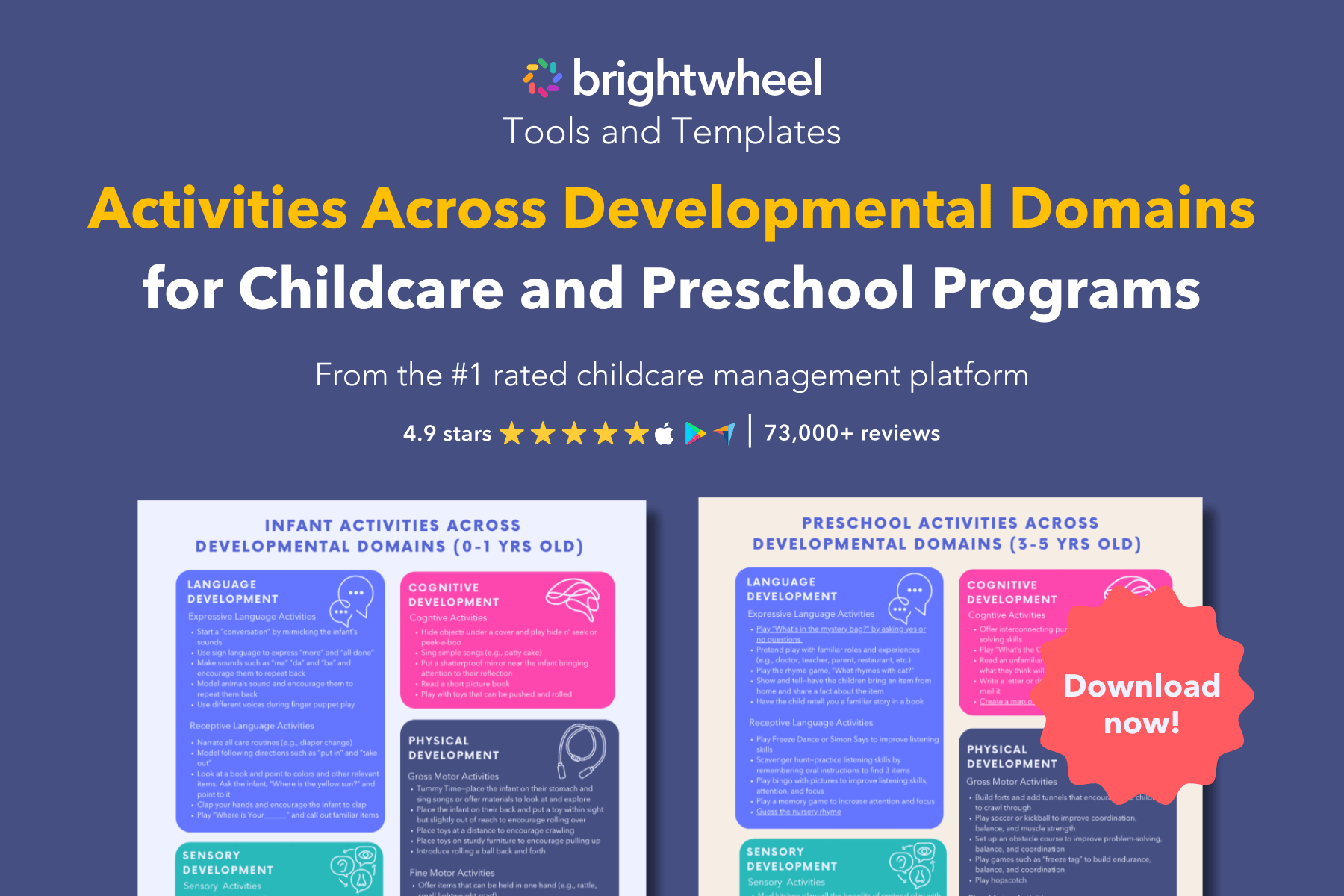
Child development activities are structured play-based interactions designed to support growth across five key domains: cognitive, physical, social-emotional, language, and sensory. For childcare providers, integrating these activities into daily routines helps infants, toddlers, and preschoolers reach essential milestones through age-appropriate engagement.
Planning curriculum around developmental domains ensures that you support the whole child. While it is easy to focus on obvious skills like walking or talking, a balanced approach ensures children build a strong foundation in all areas.
By understanding these domains, educators can create a rich learning environment that supports holistic growth. This approach allows you to identify potential delays early and provide families with specific insights into their child's progress.
Our free downloadable guide offers 100+ specific child development activities, but here is a breakdown of the core domains you should focus on in your childcare program.
Cognitive activities help children process information, reason, and solve problems.
This domain covers large muscle movements (gross motor) and small muscle control (fine motor).
These activities teach children how to understand their feelings and interact with others.
This focuses on communication, vocabulary, and early reading skills.
Sensory play helps children make sense of the world through touch, sight, sound, taste, and smell.
Ready to expand your curriculum? Download our free guide to access a comprehensive list of ideas tailored for every age group in your program.
Download this guide to:
Q: How often should I rotate child development activities?
A: Rotate activities every one to two weeks to keep children engaged while allowing enough repetition for mastery. Observe the children’s interest levels; if they seem bored or frustrated, it is time to switch to a new activity.
Q: Can one activity cover multiple developmental domains?
A: Yes, most activities support multiple domains simultaneously. For example, a "Simon Says" game supports physical development (movement), cognitive development (following rules), and language development (listening skills) all at once.
Q: How do I adapt activities for children with different needs?
A: Observe each child's current abilities and modify the activity to be slightly challenging but achievable. This might mean using larger tools for fine motor tasks or providing visual aids for language activities to ensure inclusivity for all children.
After downloading this guide, check out these other resources to support your childcare program: