A free checklist to simplify childcare licensing
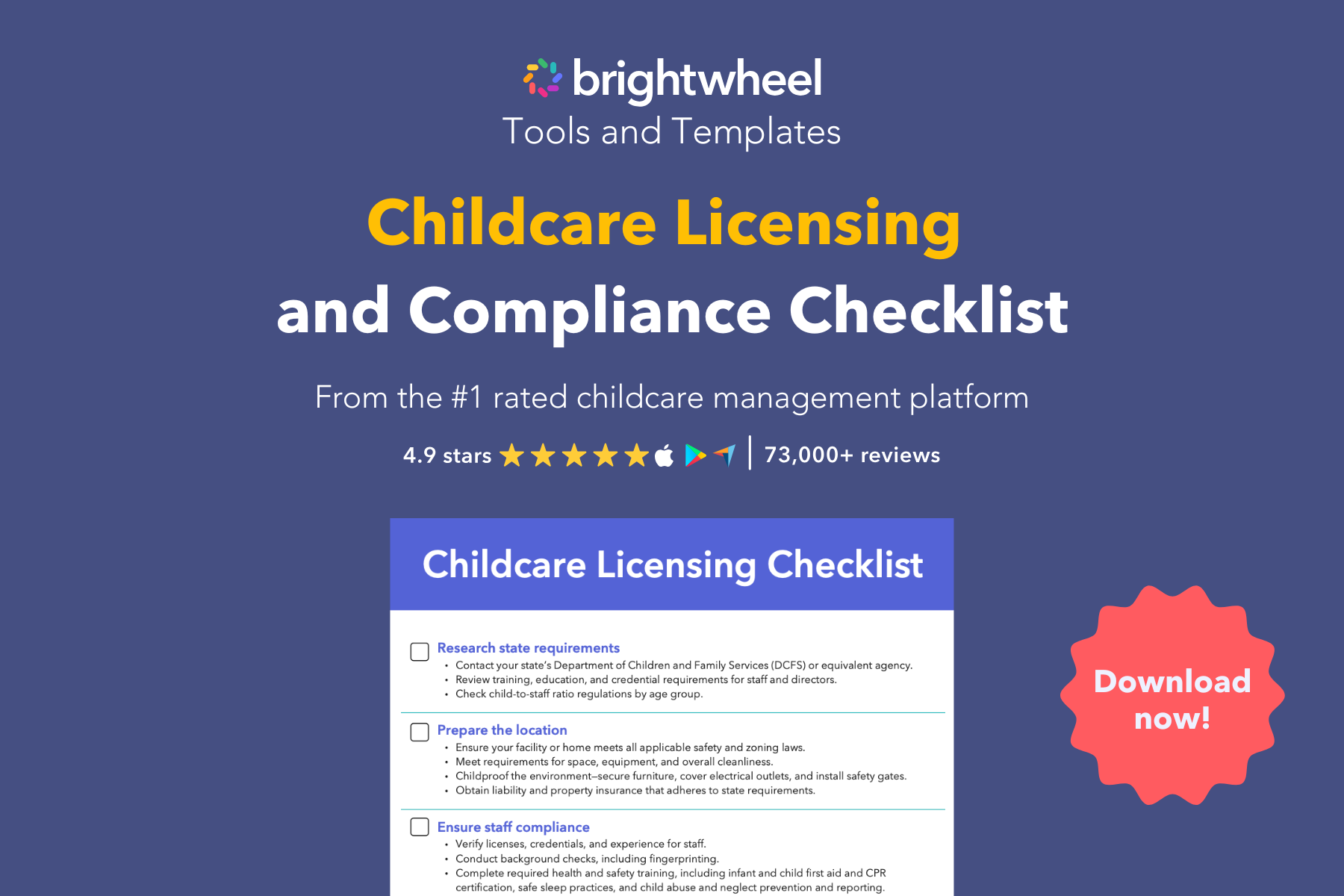
Childcare licensing is the official process of obtaining state approval to operate a childcare program, ensuring the facility meets established health, safety, and educational standards. Compliance with these regulations is mandatory for most providers to ensure a safe environment for children and to qualify for state and federal funding.
Why is childcare licensing important?
Obtaining a license demonstrates to families that your program meets rigorous safety and quality standards. Beyond safety, being licensed often unlocks access to state subsidies, food programs, and grants that can support your business.
Navigating the childcare licensing process can be complex, and staying compliant with regulations requires ongoing attention. This free, tailored checklist is designed specifically for childcare providers, making the entire process more manageable and organized.
Download this free childcare licensing checklist to:
- Understand the key steps to obtain your childcare license
- Learn the benefits of operating a licensed program
- Access tips for maintaining compliance with ease
- Get links to crucial state and federal resources
How to use this childcare licensing checklist
Whether you are opening a new center or managing an existing one, maintaining compliance is an active process. This checklist helps you break down complex regulations into simple, actionable steps. By staying organized, you can avoid costly violations and focus on creating a nurturing environment for the children in your care.
Key steps in the licensing process
While requirements vary by state, the general path to licensing involves:
- Research: Identify the specific regulations for your state and program type.
- Preparation: Ensure your facility meets safety codes and staff meet educational requirements.
- Application: Submit your comprehensive application and background checks.
- Inspection: Pass an onsite health and safety inspection.
After downloading the childcare licensing and compliance checklist, explore additional early education resources to enhance your childcare business operations:
Frequently asked questions
Q: How long does it take to get a childcare license?
A: The timeline varies significantly by state and license type, typically ranging from three to twelve months depending on the speed of background checks and facility inspections.
Q: What is the difference between a licensed and license-exempt program?
A: Licensed programs must meet strict state regulations and undergo inspections, while license-exempt providers (often legally operating in-home care for a small number of children) have fewer regulatory requirements but may have limited access to public funding.
Q: How often do I need to renew my childcare license?
A: Most states require license renewal every one to two years, though this often involves an annual inspection or review to ensure continued compliance with safety standards.
Common childcare licensing terms
Understanding the specific language used in state regulations is the first step toward compliance. This glossary defines key terms you will encounter during the licensing process.
- Accreditation: A voluntary process where a childcare program undergoes a rigorous evaluation to demonstrate it meets high-quality standards that go beyond basic state licensing requirements. Often granted by national organizations like NAEYC (National Association for the Education of Young Children).
- Background check: A mandatory review of an individual's criminal and abuse history. Required for all staff members, volunteers, and household members over a certain age in family childcare homes to ensure eligibility to work with children.
- Capacity: The maximum number of children a childcare program is legally allowed to care for at one time, determined by the size of the facility, number of available toilets and sinks, and fire safety codes.
- Compliance: The state of adhering to all laws, rules, and regulations set by the licensing agency. A program is "in compliance" when it meets all safety, health, and operational standards needed for a license.
- Director: The person responsible for daily operations, program management, and staff supervision of a childcare center. Specific education and experience requirements apply to this role.
- Family childcare home: A childcare program located in a private residence. States often classify "small" and "large" family childcare homes based on the number of children, with differing regulations from commercial centers.
- Health and safety inspection: An onsite visit by a licensing representative to verify the facility meets physical safety and health requirements, checking for hazards, cleanliness, fire safety, and proper record keeping.
- License-exempt: Providers legally allowed to operate without a childcare license. Applies to specific programs such as those operating a few hours a day, relative care, or some religious institutions.
- Licensing agency: The state government department responsible for issuing licenses, enforcing regulations, and monitoring childcare programs, often the Department of Health and Human Services or Department of Education.
- Mandatory reporter: A professional legally required to report any suspicion of child abuse or neglect to the appropriate authorities. All childcare providers and staff are mandatory reporters.
- Provisional license: A temporary license issued to a new program that meets most requirements or to a program correcting a violation. It allows operation for a specific period while working toward full compliance.
- Ratio: The maximum number of children permitted per adult staff member. Ratios vary by the age of children, e.g., one adult per four infants (1:4) or one adult per ten preschoolers (1:10).
- Revocation: The action taken by a licensing agency to permanently revoke a program's license due to serious or repeated violations of regulations.
- Subsidy: Financial assistance from the state or federal government to help eligible families pay for childcare. Providers typically need to be licensed and meet specific criteria to accept subsidies.
- Variance (or Waiver): Permission granted by the licensing agency for a provider to deviate from a specific rule or regulation under certain conditions, provided child safety is not compromised.
- Violation: A specific instance where a program fails to meet a licensing regulation. Documented during inspections and must be corrected within a set timeframe.
